3.4 Boundaries: Where Do I End and You Begin?
The Fine Art of Caring Without Taking Over, Giving Everything Away, or Losing Yourself
We've talked about what caregiving involves, how people find themselves in the role, and why understanding our own strengths and limitations is important. Now we're going to discuss something that can make the difference between a caregiving relationship that works reasonably well and one that becomes increasingly difficult for everyone involved.
Boundaries.
I know that word gets tossed around quite a bit these days, usually in conversations about protecting our emotional well-being or learning how to say no. But boundaries are much more than a convenient way to avoid doing things we'd rather not do. They help us understand where our responsibilities begin and end, how we respect other people's rights and preferences, and what we can reasonably expect from one another.
And in caregiving, those questions can become complicated very quickly.
When we're helping someone with intimate personal care, managing their appointments, assisting with finances, or making decisions about their safety, we're entering areas of another person's life that were probably private for most of their adulthood. At the same time, we may be expected to take on responsibilities that interfere with our own employment, relationships, health, or independence.
So how do we make this work? How do we provide meaningful assistance without taking over someone's life, and how do we recognize our own limitations without feeling that we're abandoning the person who needs us?
That's what boundaries are all about.
What Exactly Is a Boundary?
At its simplest, a boundary helps us distinguish between what belongs to us and what belongs to someone else. That might involve our bodies, our time, our emotions, our responsibilities, our personal information, or the decisions we're entitled to make.
Some boundaries are physical. We decide who may touch us, how much personal space feels comfortable, and what kinds of physical assistance we're willing to receive or provide. Others involve privacy, emotional relationships, financial decisions, personal beliefs, or expectations about availability.
And boundaries aren't necessarily the same for everyone. What feels perfectly comfortable to one person may be deeply uncomfortable to another, even when both people have the best intentions.
I learned something interesting about that during COVID. I'm a hugger, and suddenly finding myself reduced to awkward waves and shoulder bumps felt like a genuine loss. I hadn't realized how much I relied on physical affection as a way of connecting with people.
My husband, on the other hand, was delighted. He's never been particularly enthusiastic about strangers entering his personal space, and the expectation that everyone maintain a little distance suited him just fine.
Same circumstances, two completely different experiences.
Neither of us was necessarily right or wrong. We simply had different expectations about physical boundaries, and those differences became much more noticeable when circumstances changed.
Now imagine bringing those differences into a caregiving relationship, where physical contact, personal privacy, emotional expectations, and responsibilities may change almost overnight.
Personal Boundaries: What Am I Comfortable With?
I'd like you to think about your own boundaries for a moment. You don't need to write them down or share them with anyone, but consider what makes you comfortable, what makes you uneasy, and where you might have difficulty expressing your limits.
Maybe you're comfortable discussing almost anything with your family but consider financial matters intensely private. Perhaps you're perfectly willing to help someone with errands or household responsibilities but feel uncomfortable providing intimate personal care.
Some people are comfortable asking for help, while others would rather struggle for hours than admit they can't manage something independently. Some are comfortable with disagreement and confrontation, while others will agree to almost anything simply to avoid an uncomfortable conversation.
None of these tendencies automatically makes someone a good or bad caregiver. But understanding them can help us recognize where conflicts might arise.
As you look at the illustration, consider the different kinds of boundaries involved in your everyday relationships. Physical, emotional, intellectual, financial, and personal boundaries may all influence how we approach caregiving, and we don't necessarily recognize them until someone challenges one.
The difficulty is that caregiving often requires us to negotiate boundaries that were never meant to be crossed in our previous relationships.
Personal Boundaries
Personal boundaries can include our values, ethics, belief systems, morals, and religious or spiritual belief systems. What are your personal boundaries? In my personal life, I am probably far to flexible in what I am willing to accept in the behavior of others. I admit that the older I get, the less tolerant I am of certain things that people do, but I have also become far more capable of discerning when issues belong to me, or someone else! The hardest thing for me to adjust to during COVID was personal space. I'm a hugger, and being reduced to a shoulder bump was profoundly uncomfortable - I felt a loss. However, my spouse was SO happy, because he just hates when strangers get within a 2' radius of his body. These were boundaries that I didn't even know existed!
What are some of your personal boundaries? (Don't answer that in writing, just think about it.) What can you tolerate, what do you enjoy, what makes you tense? Look at the graphic to the left. Are any of these types of boundaries clearly defined in your mind?
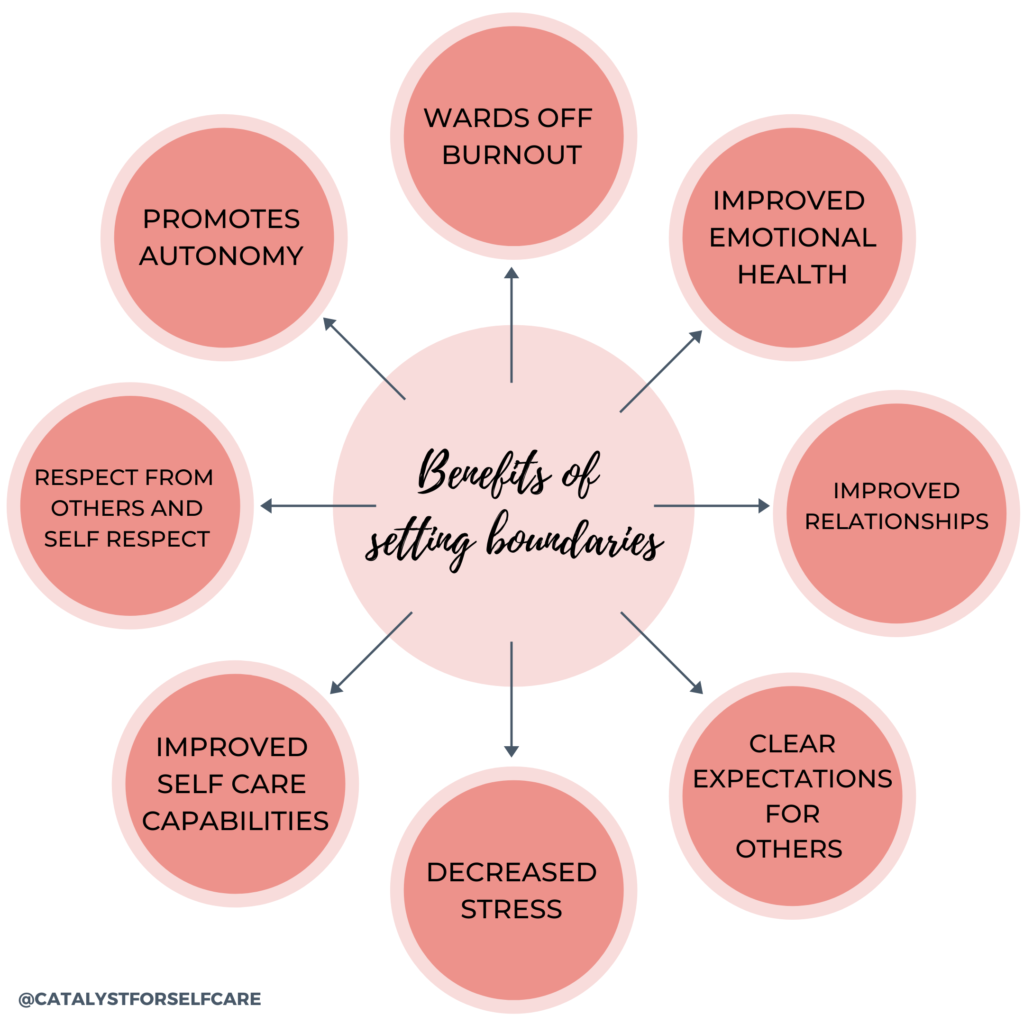
When we are caregiving, we may be asked to cross some boundaries - either our own or the person for whom we are providing care. It's essential that we have the conversation about boundaries BEFORE we find ourselves in conflict.
Here's an example. Parents often hold very strong boundaries when it comes to sharing personal finance with their children. However, if you are going to be the primary caregiver, and need to manage bills or insurance, how will you cross that boundary?
What about personal care? Truly, I believe that no one wants someone else to help them use the toilet. However, that level of intimacy may be the reality of some caregiving situations. Do you mind doing the task of sanitary care? If not, how will you handle that boundary? How can you convince mom or dad that it's okay for you to help them care for this task?
Can you say "no"?
One of the hardest lessons for many is the art of saying no. It can be especially hard for those raised with "filial piety" - the belief that we must respect and care for our parents in their old age - no matter what. However, learning when and how to say no is one of the most important things a family caregiver can do to set healthy, sustainable boundaries with their loved ones and the rest of their caregiving team — but it can also be a difficult step to take.
Opens the original video in a new tab.
When the Relationship Changes
Let's imagine an adult daughter whose mother has always managed her own finances. Mom has never discussed her bank accounts, investments, or bills with her children, and she's quite comfortable keeping those details private.
But now she's beginning to have difficulty remembering whether she's paid her bills. The daughter becomes concerned about missed payments, financial scams, and the possibility that her mother may be struggling to manage responsibilities that once seemed effortless.
How does the daughter offer assistance without simply demanding access to her mother's finances?
That's a boundary question, and it involves both people.
The daughter may feel responsible for protecting her mother from financial harm, while the mother may feel that she's being asked to surrender an important part of her independence. Both perspectives deserve consideration, and neither automatically cancels out the other.
Depending on the mother's abilities and preferences, the solution might involve reviewing bills together, arranging reminders, using automatic payments, or discussing whether she wants to authorize someone to assist with financial management.
The important point is that caregiving doesn't automatically give one person the authority to take control of another person's finances. Legal decision-making authority, consent, and the older adult's capacity all matter.
And the same tension appears in many other caregiving responsibilities.
The Intimacy of Personal Care
Now let's consider something even more personal.
Most of us have spent our adult lives bathing, dressing, and using the toilet without assistance. These are private activities, and we generally expect to control who has access to our bodies.
But illness, disability, or cognitive changes may eventually make assistance necessary.
Imagine how uncomfortable it might feel to have your adult child helping you bathe or use the toilet. Or consider how the child might feel about providing that assistance, particularly if the relationship has always involved fairly strong expectations about privacy.
Sometimes both people are uncomfortable, but neither knows how to acknowledge it.
And that's where communication becomes essential.
Rather than assuming that assistance will simply be accepted, caregivers can explain what needs to happen, ask about preferences, offer choices, and protect as much privacy and independence as possible.
Perhaps the person would prefer a professional caregiver for intimate care. Maybe they're comfortable accepting help from a daughter but not a son, or they want assistance with setting up the bathroom while continuing to wash themselves.
There may be cultural, religious, personal, or relational reasons behind these preferences, and we shouldn't dismiss them simply because a particular arrangement would be more convenient.
We also need to acknowledge the caregiver's boundaries. Not everyone is physically capable of providing transfers, comfortable with intimate care, or trained to perform certain procedures.
Providing care shouldn't require us to disregard the dignity or safety of either person involved.
Can You Say No?
Here's a question that sounds deceptively simple.
Can you say no?
I don't mean whether you know how to pronounce the word. I mean whether you can establish a limit when someone needs assistance, expects you to provide it, and may be disappointed or angry when you explain that you cannot.
For family caregivers, this can be particularly difficult because expectations are often tied to relationships and family values. In some families, caring for older parents is understood as a fundamental responsibility, sometimes described through the concept of filial piety. These obligations may be shaped by cultural traditions, personal beliefs, family history, and expectations about reciprocity between generations.
Those values can provide meaning and strengthen family relationships, but they can also create tension when expectations exceed what a particular family member can realistically provide.
Imagine a daughter who works full-time and has children at home. Her father wants her to visit every evening, prepare his meals, and accompany him to every medical appointment. She wants to help, but the arrangement is becoming impossible to sustain.
Saying no to some of those expectations doesn't necessarily mean she doesn't care about her father. It may mean that the family needs to reconsider how responsibilities are distributed, whether additional services are available, or which tasks actually require her personal involvement.
And sometimes the conversation will be uncomfortable.
The goal isn't to avoid disappointing anyone. It's to develop a caregiving arrangement that is realistic, respectful, and sustainable.
Professional Boundaries: A Different Kind of Relationship
Now let's shift our attention to professional caregivers, because the same issues can appear in somewhat different ways when caregiving is paid employment.
A professional caregiver may develop a close and meaningful relationship with someone receiving care. They may spend considerable time together, share conversations, celebrate important events, and become familiar with one another's personalities and preferences.
Those relationships can be enormously valuable, particularly for older adults who have limited contact with family or friends.
But professional caregiving also involves a difference in power and responsibility.
The person receiving care may depend on the caregiver for assistance with intimate personal needs, access to services, or emotional reassurance. The caregiver, meanwhile, is expected to act within their training, job responsibilities, professional standards, and organizational policies.
That means the relationship cannot operate exactly like an ordinary friendship.
For example, a resident may ask a caregiver to lend them money, keep a secret from the healthcare team, or provide assistance outside the caregiver's professional responsibilities. A family member may ask for the caregiver's personal telephone number or expect them to provide unpaid assistance outside work.
These requests may arise from genuine needs or affection, but they can create complicated expectations and conflicts of interest.
Maintaining appropriate professional boundaries helps protect the resident, the caregiver, and the integrity of the caregiving relationship.
When Caring Becomes Too Personal
I want to be careful here, because I don't believe professional caregivers should be emotionally detached from the people they support.
In fact, warmth, compassion, and genuine interest are among the qualities that can make caregiving meaningful.
But there is a difference between caring about someone and becoming personally responsible for meeting every emotional need they experience.
Imagine a CNA working with an older gentleman who reminds her of her father. They share an interest in music, enjoy talking together, and develop a comfortable relationship. Over time, the resident begins asking specifically for her whenever he needs assistance, and he becomes upset when she's unavailable.
The caregiver may feel flattered by the connection and genuinely enjoy spending time with him. But what happens when she begins neglecting other residents to provide him with extra attention, or when she feels personally responsible for preventing him from ever experiencing loneliness?
The relationship has begun shifting in ways that may create problems for both people.
That doesn't mean the connection itself was inappropriate. It means the caregiver needs to recognize when their involvement is moving beyond the responsibilities of their professional role.
And that can be particularly difficult when the caregiver and resident have something meaningful in common.
Perhaps the resident reminds the caregiver of a deceased parent, shares a familiar family history, or seems especially vulnerable because they have few visitors. Those similarities may deepen empathy, but they can also make it harder to recognize when professional responsibilities and personal emotions are becoming entangled.
The important skill isn't avoiding emotional connection. It's recognizing how that connection may influence our decisions and behavior.
The Red Flags: When Boundaries Begin to Blur
There are several situations where caregivers should pay closer attention to their boundaries.
Perhaps you find yourself regularly staying after work because one resident doesn't want anyone else providing assistance. Maybe you're purchasing gifts, lending money, or accepting responsibilities that aren't part of your job. You might begin sharing personal information with someone receiving care because you feel unusually close to them, or find yourself becoming angry when family members make decisions you disagree with.
Family caregivers experience their own versions of these situations. Perhaps you're responding to telephone calls at every hour, canceling important appointments because someone refuses alternative assistance, or feeling responsible for solving every problem that arises.
Sometimes these patterns develop so gradually that we don't recognize what's happening until we're exhausted or resentful.
And here's something worth remembering: a boundary doesn't have to be violated dramatically to become a problem. Often, boundaries erode through a series of small decisions that seem perfectly reasonable at the time.
The solution begins with recognizing the pattern, considering whose needs are being met, and deciding whether the arrangement is appropriate.
For professional caregivers, that may involve seeking guidance from a supervisor or another member of the care team. For family caregivers, it may involve discussing expectations, redistributing responsibilities, or identifying additional resources.
In either case, the goal is to address the problem before the relationship becomes increasingly difficult to manage.
Boundaries and Burnout
We've already discussed the physical and emotional demands of caregiving, particularly in long-term care environments where workers may have substantial responsibilities and limited control over their schedules.
But burnout isn't simply the result of someone failing to establish personal boundaries. Staffing shortages, inadequate training, financial pressures, complicated medical needs, and limited access to support can all contribute.
And family caregivers may face circumstances over which they have very little control, particularly when affordable assistance is unavailable or the person receiving care has extensive needs.
So I don't want you to leave this lecture believing that every caregiving problem can be solved by becoming better at saying no.
Sometimes we need to establish clearer expectations. Sometimes we need additional training or assistance. And sometimes the problem is not the caregiver's personal boundaries at all, but an arrangement that asks one person to accomplish more than is realistically possible.
Understanding those differences is important because boundaries are part of sustainable caregiving, but they cannot substitute for adequate resources and support.
Confidentiality: Some Things Aren't Yours to Share
Now let's discuss one of the most important professional boundaries: confidentiality.
When you're providing care, you may learn extraordinarily personal information about another human being. You may know about their diagnoses, medications, finances, family relationships, personal history, or difficulties with everyday functioning.
Some of that information is necessary to provide appropriate assistance. But the fact that you've learned something through your caregiving role doesn't mean you're free to share it with other people.
Imagine working in a skilled nursing facility and discovering that a resident has a medical condition they haven't discussed with their family. Or perhaps you overhear a conversation about another resident's finances or personal relationships.
You may be curious. You may even be concerned. But curiosity doesn't establish a professional need to know, and knowing something doesn't automatically give you permission to discuss it.
Confidentiality is an ethical responsibility, and in many healthcare settings it is also governed by law.
What Does HIPAA Actually Require?
The Health Insurance Portability and Accountability Act, commonly called HIPAA, establishes important privacy requirements for covered healthcare organizations and their business associates.
These rules generally protect identifiable health information and regulate how it may be used, accessed, and disclosed.
But HIPAA isn't quite as simple as saying that nobody can discuss a person's medical information without written permission.
For example, healthcare professionals may share information when necessary for treatment, and healthcare providers may communicate relevant information with family members or friends who are involved in someone's care under circumstances permitted by the Privacy Rule.
When a patient is able to make their own decisions, their preferences and objections matter. When someone is incapacitated, healthcare providers may sometimes share relevant information with involved caregivers when doing so is in the patient's best interests.
And someone who has legal authority to act as a patient's personal representative may have additional rights to information.
The important distinction is that family relationships, caregiving responsibilities, and legal decision-making authority aren't all the same thing.
Being someone's spouse or adult child doesn't automatically establish unrestricted access to every medical record. Conversely, HIPAA doesn't prohibit all communication with family caregivers simply because they don't hold a power of attorney.
For professionals, the safest approach is to understand your organization's privacy policies, know what information you're authorized to access or share, and seek appropriate guidance when you're uncertain.
And that includes being thoughtful about casual conversations, electronic messages, photographs, social media, and the use of personal devices.
The Need-to-Know Principle
I like to think about confidentiality through a simple question: Do I need this information to carry out my responsibilities, and am I authorized to access or share it?
If you're responsible for helping someone with medications, you may need information about their medication schedule and relevant precautions. If you're coordinating transportation, you may need to know when and where an appointment is taking place.
But that doesn't necessarily mean you need access to every detail of the person's medical or personal history.
HIPAA includes a minimum-necessary standard for many uses and disclosures of protected health information, although there are important exceptions, including disclosures between healthcare providers for treatment.
The broader principle remains useful for caregivers: respect personal information, avoid unnecessary access or disclosure, and follow the applicable rules.
And family caregivers should think about privacy, too, even when HIPAA doesn't directly regulate their personal activities. If Mom tells you something about her medical condition, that doesn't automatically mean the entire family needs an update. Her preferences and privacy still matter.
So How Do We Maintain Healthy Boundaries?
I wish I could give you a universal formula that would work in every caregiving situation, but relationships are considerably more complicated than that.
What I can offer is a practical starting point.
First, recognize your own limits and responsibilities. Understand what you're comfortable doing, what you're trained and authorized to do, and what assistance you can realistically provide.
Second, listen to the person receiving care. Their preferences, values, and concerns may differ from yours, and those differences deserve consideration whenever possible.
Third, communicate expectations before a problem becomes a crisis. It's much easier to discuss responsibilities, availability, privacy, and decision-making when everyone is relatively calm than when someone is exhausted, frightened, or angry.
And finally, recognize when you need assistance. Professional caregivers have supervisors, colleagues, and organizational procedures. Family caregivers may need support from relatives, community organizations, healthcare professionals, or paid services.
None of this means that boundaries will prevent every difficult situation. They won't.
But they can help us recognize problems earlier and respond in ways that protect the well-being and dignity of everyone involved.
One Last Thought
I think one of the most difficult things about caregiving is that the better we become at helping someone, the easier it is to forget that we're two separate people.
The person receiving care has needs, preferences, fears, and expectations. The caregiver has responsibilities, abilities, limitations, and a life of their own.
Those realities aren't in competition simply because they don't always align perfectly.
Sometimes the most appropriate caregiving response involves offering assistance. Sometimes it involves encouraging independence, asking for help, communicating a difficult truth, or explaining that a particular responsibility cannot safely or reasonably be provided.
And sometimes it means recognizing that someone else's discomfort or disappointment doesn't automatically mean we've done something wrong.
As we continue exploring communication and caregiving relationships, I want you to remember that boundaries aren't about becoming distant, unkind, or unwilling to help.
They're about learning how to remain caring, competent, and respectful without losing sight of the fact that both people in the caregiving relationship matter.
And that takes practice.