🎓 Lecture: Memory and Intelligence
So, we have all this capacity to retain all of this great information. What do you do with it? We learn. Learning is what happens when we achieve knowledge and can "do" something" with that knowledge. We learn that if we take the information we've put into our brains and do something with it, we can control our environment. Intelligence is most often measured by standardized testing. Many such tests are criticized as being ethnocentric (biased towards the major culture), sexist (biased towards boys or men), and ageist (an inadequate measure of applied knowledge). (Samuda, et al., 1975)
We need to be able to retrieve our memories. The ability to retrieve memories and use them to make decisions is what we call intelligence. Intelligence is defined as the theoretical limit of our ability to pull out that knowledge and information.
One way we measure intelligence is through traditional IQ tests, which measure our ability to make judgments and exercise comprehension and reasoning. There are, however, lots of different intelligences, and we've recognized each of them more and more in brain and memory research. I expect you have read about emotional intelligence. But, what about musical intelligence or mathematical intelligence? Just because you don't score highly on a traditional IQ test does not mean you are not intelligent. (Schaie, 2005)
Fluid vs. Crystallized Intelligence
I'd like you to imagine fluid intelligence in terms of the metaphor of a jar that is filled with saltwater - that saltwater represents your potential for intelligence on the day you are born. Nothing is fixed. You "know" nothing. The moment you are born, you take the top off that jar, expose the saltwater to the elements, and little crystals start to form. Those little crystals represent what would be your crystallized intelligence. It's a collection of tiny learning moments that get stored away as things that you "know."
Throughout the course of your life, your jar just keeps getting exposed to more and more, and while you never exceed the capacity of your jar, it gets pretty darn full.
Concurrently, as we gain more crystallized intelligence, we lose fluid intelligence. We trade off the ability to learn and adapt quickly for a wealth of wisdom and knowledge. We NEVER run out of fluid intelligence, so don't worry! Those people who tell you that you can't teach an old dog new tricks? Well, they're wrong.
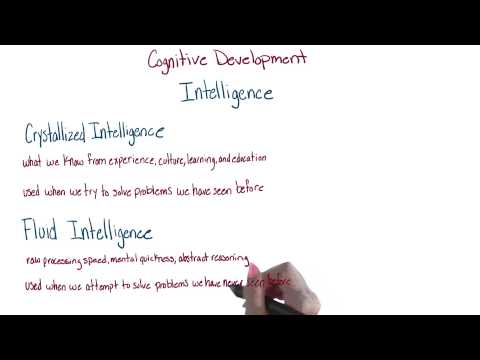
(Source: Udacity.com)
Different aspects of cognition are affected in various ways over time. One measure of cognitive ability is intelligence. A commonly-used system of categorizing intelligence is into "fluid" and "crystallized" intelligence.
Fluid intelligence (also called "native mental ability") is the information processing system. It refers to the ability to think and reason. It includes the speed with which information can be analyzed and also includes attention and memory capacity. (Gray, 2003)
Crystallized intelligence is accumulated information and vocabulary acquired from school and everyday life. It also encompasses the application of skills and knowledge to solving problems.
Many studies have shown that fluid intelligence is more likely to decline with age than crystallized intelligence. In fact, crystallized intelligence may continue to improve with age. Many people continue to gain expertise and skills in particular areas throughout life. (Horn, 1982; Stankov, 1988)
It is theorized that much of the cognitive decline with age can be traced back to deficits in the information processing system (fluid intelligence). Age generally does not affect tasks that use well-practiced skills or familiar information. However, complex tasks that require taking in new information and analyzing it may become more difficult. Many researchers attribute this to deficits in attention, processing speed, and memory.
When we are young, we work hard to build those crystals with all that fluid intelligence. How do we do it? Through song, repetition, rhymes, and other learning tools. It takes a LOT of metabolic energy to create long-term memory, so give credit to yourselves for all the hard work you've done so far!
Like you, we have a pretty hefty jar of crystals when we are a little older. The job you have in adulthood is linking them together in ways that help you. It is far easier to build on an existing knowledge base than to learn an entirely new one. That's one reason this class feels easy for a lot of students - it's building on what you already know best…your own knowledge of self and family.
Adult learning theory is based on the premise that you will be better learners if, as your teacher, I give you opportunities to link new knowledge with something you already know. It's also the reason that most teachers who use adult learning theory in their classrooms start lessons with words like, "I want you to think about your life," or "Remember what we did last week."
It's also the reason why some subjects are more challenging to learn than others. If you have no foundation upon which to build new linkages, you have to create one from your fluid intelligence - you're forming a new crystal, and that's exhausting (but exciting!)
Does Intelligence Change Over Time?
Measures of intelligence tell us that there is a decline in fluid intelligence, NOT crystallized intelligence. We see it if we give a younger and older person a task - it could be a manipulative puzzle like a jig-saw or a word scramble. If we do not time the test, scores are almost always the same. The moment we put a timeframe on the task, we see the younger person's scores elevate. This phenomenon is called the "classic aging pattern" and indicates a decline in the ability to process information or complete tasks in an efficient manner or a simple fear of tests. (Schaie, 2005)
How do we measure pure intelligence, though? I propose that it has more to do with processing ability. We find that there may be a slow decline in one or two areas of primary memory. If, for example, I am being asked to do a manipulative puzzle or complete a task with a pen or pencil, and I have developed arthritis, my speed will be slower. If my sense of touch has been interrupted by some neurological degeneration, it's going to be really hard for me to hold a pencil and quickly fill out bubbles on a scantron or pick up small puzzle pieces. If I'm experiencing vision changes, it might be more difficult for me to read the instructions. If I have degeneration in my hearing, it might influence my ability to hear directions and follow them.
We do know that there is a decline in fluid intelligence. We don't see a real drop-off in processing until about age 80. That's when we start seeing declines in our ability to connect words to meanings, spatial orientation, inductive reasoning, and the number of words in fluency. New research tells us that we reach an ideal balance of fluid and crystallized intelligence around age 40 and stay at a peak until we are in our late 70s. Before that, we are more fluid than fixed and have less from which to pull our ideas and actions. That's why we talk about age bringing wisdom!
Wisdom and Creativity
The biggest indicator that we've done a good job and are learning in our knowledge retention and our knowledge to pull information out is when we achieve enough experience to coalesce all these things. Sometimes we're using our knowledge and intelligence in a function that we call wisdom. We take our factual and procedural knowledge, combine our personal experiences, and understand that all of this is happening contextually to manage a new situation. It allows us to have a broader context for the decisions we make.
Creativity is about taking everything we know, combining it, and pulling it out in a totally new way. We measure creativity by divergent thinking. We measure wisdom by how well we manage uncertainty.