🎓 Lecture: The Aging Mind
 The Psychology of Aging
When I ask students what their greatest concerns about aging, most frequently they express reticence about physical aging and loss of mental function. I often think about what is going to happen to my own body, my own mind. We have a lot of fear wrapped up in these potentials and possibilities, but most often I find that knowledge can conquer fears. So, let’s take a look at cognitive function and see what is within a normal range, and what we need to be concerned about.
Mental stress and mental disorders take a significant toll on the health and productive functioning of anyone, older adults included. Regardless of stereotypes, you will learn that most older people are in good mental health.
An estimated 22% of older adults have a mental disorder, with the highest rates being found among older adults living in institutional settings, such as nursing homes. Typically 50% of nursing home residents suffer from some type of mental disorder, and nearly a quarter of all hospital costs for older adults are due to treatment of mental health problems.
However, because of the stereotype that all older people become senile as they age, no one becomes alarmed if an elderly person has hallucinations or delusions. It has been widely accepted that people’s minds go away as they age. As you have probably guessed, if senility comes, it is not the result of the aging process. There are many different causes of dementia. This is NOT normal or usual aging.
Declining mental health is not a natural consequence of aging. Most non-institutionalized people over the age 65 are in good mental health.
If they are not, the causes are not due to the aging process itself, but instead to other causes that can usually be pinpointed.
Let’s start out looking at a basic understanding of memory and learning. How does your memory work? How does your brain work? What happens in NORMAL aging vs. abnormal degenerative decline?
From the moment we are born, we are collecting information. That information comes to us through our sensory organs - our sense of touch, taste, vision, smell, and hearing. Our nerve endings function as tiny receptors that sense the tiniest stimulation. That information gets sent to our brain, which has to figure out what it means. Over time, our brain tissue learns to recognize these signals and assign or perceive meaning.
Cognitive psychology is the study of mental processes. Everything you think and everything you feel in your body comes from the outside world through your five senses. Cognition the mental action or process of acquiring knowledge and understanding through thought, experience and the senses.
We first experience the environment through our five senses (see, touch, hear, smell, and taste), and our senses relay this environmental information (sensory input) to our brains. Without these senses, we would not be able to experience our world.
We learn to recognize things based on our culture, which appeal to us, based on our strengths. Many factors influence whether a person feels something more acutely than another. What do you see when you look at this image?

Some of you will see two faces looking at each other. Others will see a candlestick. What I find fascinating is how many of you can move from perceiving one image to the other. In some of you, the light color attracted your eye first; for others,, the dark. Some of you were looking for symmetry, and others for the abstract.
Let’s try another one. Do you see anything wrong with this image?

How long did it take you to find the mistake? If you still haven't seen it, check out the number of times the word "the" appears. Isn't it interesting? Part of it is that we don't perceive and process every signal in our perception practice. We fill in the blanks. We skim over unnecessary information to get to a predictable pattern. We anticipate what is going to happen. We are continually processing and accumulating information through our senses. We learn what each sense means and eventually figure out our position in the universe - up, down, hot, cold, pleasure, pain.
How do we find common ground in the world if we process information differently through our senses and perception? As humans, we can take those processes and store them for future use.
The Brain as an Information Processor
Let's just talk about YOU. How do YOU learn? Do you think that learning stops at a certain age? I'm a firm believer that we never lose the capacity to learn. I also am a firm believer that what changes is our willingness to alter our beliefs or adapt our ideas to accommodate new information. We may "like" to learn, but we like it more when what we are learning aligns with our prior experiences! Otherwise, learning may feel quite difficult and uncomfortable. There's a good reason for that. Read on!
Cognition is the mental process that we use for perceiving, remembering, and thinking. In general, research shows that we are at our peak in cognitive ability around age 40. It isn't until age 60 that we start seeing any decline, but the changes are not significant at this point. The effects of cognitive changes are not usually significant until after age 70, and even then, these changes are quite individual. Research on intelligence over a lifetime showed that by age 80, only 30-40% of participants showed any rate of decline. (Hartshorne, 2015)
It's all about Perception
At its basic core, our brain is a lot like a computer. Our sensory memory takes in information, our short-term memory helps us decide whether to hold on to the information, and our long-term memory stores everything we determine to be worthwhile.
In order to get information into our brains, we rely on our sensory organs to function. It's actually quite remarkable what a normal, healthy person's nerve endings are capable of picking up.
The human senses can do amazing things. We have these very cool "absolute thresholds" that are the minimum amount of stimulus that we can process. Imagine this:
- The human eye can perceive the light of a candle flame at 10 miles (in the absolute dark).
- We can smell one drop of perfume in a 3-bedroom apartment.
- For me, it's not the flutter of a bee wing on m cheek. It's the day I walk into the cobweb that the garden spider likes to leave as a trap for me between two rose bushes in my garden. I end up doing the "spazzy spider dance," which is probably the most aerobic exercise I get all year. It feels like I walked into a piece of rope, and I imagine little spider feet on my neck for two hours afterward!
- We can even taste one tablespoon of sugar when diluted in one full gallon of water.
We also have maximum thresholds - those moments where our bodies cannot tolerate additional stimuli. For example, have you ever had a sudden loud noise or the volume in a dance club or concert hurt your ears? I'm not talking about the ear-ringing afterward, but the moment when you reflexively reach up to cover your ears to block out the additional volume. What about the last time you were in a low-light environment, and a clever friend decided to use the flash feature for a selfie. Ouch! Right?
Does our absolute threshold change with age? Yeah, a little bit. Each of our sensory organs experiences changes, but it's pretty individual most of the time. The areas where we seem to see the most change are with vision and hearing. The good thing is that with age, normal aging, a decline in this sense is not inevitable. There may be shifts in how we process stimuli and how we value (or not) information and input. We may have minor declines in our distance or near vision or a reduction in our hearing - but they may be more related to our environment than our age!
How Do the Senses Change as We Age?
The receptor neurons in each sensory system deal with different kinds of energy, but they all do the same job. They are designed to help us negotiate our way through time and space and understand/process stimuli to keep us safe and healthy. Unfortunately, as we age, sensory organs sometimes decrease sensitivity levels.
Hearing
About one out of every three people ages 65-74 and about half of those over age 85 have hearing loss that interferes with daily life.
Presbycusis (pronounced pres by cuss us) is the term for progressive hearing loss associated with old age. The hair cells and nerve fibers that support the auditory nerve inside the inner ear are degenerating.
Presbycusis tends to affect high-frequency hearing loss, and it becomes harder to distinguish the voices of women and children because of the higher pitch of their voices.
For this reason, never yell at someone who has a hearing loss due to age. As you yell, the pitch of your voice increases, making it harder for the person to hear you. A man's voice is lower in pitch and easier than a woman's voice to hear for someone with an age-related hearing loss. Someone with presbycusis may be able to hear low rumbles like those of the furnace turning on in the basement.
High-frequency hearing declines steadily, beginning as early as age 20, but most people don't notice any hearing loss until their 60s when voices can become less audible as low- frequency hearing also begins to fade. Although presbycusis is progressive, the rate of its progress varies with the individual. Some people at age 80 have much better hearing than others who are just aged 60.
Heredity affects how much hearing you lose and how quickly you lose it, as does exposure to loud music, roaring traffic, and other ear-splitting noise. Audiologists (hearing specialists) suggest keeping loud noise, such as kitchen blenders and hair dryers, to a minimum. If you use these products daily, you might consider a low noise model.
Hearing aids can help, but no more than one out of five older adults who need aids owns one, and fewer than half of those over age 75 who own one use it regularly. However, most hearing aids magnify background noise as well as the sounds a person wants to hear. Newer, more expensive microchip technology can filter out distortion. Volume can also be adjusted. Many people with hearing loss compensate for it by relying more heavily on visual clues, such as facial expressions. Be sure to face someone with a hearing loss when talking to him/her.-
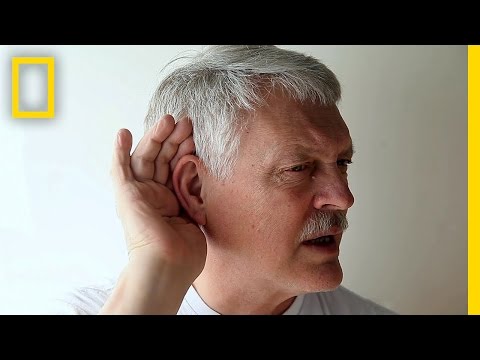
Just for fun, I'm going to play you a little video about sound and how our ability to hear certain frequencies changes with age. Turn UP your volume in order to participate!
Vision:
Because vision has been shown to compensate for other sensory losses, the effects of its loss are far-reaching. Adjusting to visual loss requires learning new self-care skills, which many elderly fail to accomplish. Most, for example, do not learn how to read Braille.
Vision loss can be extremely traumatic for those experiencing it. It can limit mobility, increase the likelihood of accidents, impede recreational activities, and increase fear and isolation.
Presbyopia is the eye change that usually takes place around age 40 when one begins to hold books out at arm's length. The changes seem rapid at first but eventually level off. Near vision is affected as the lens loses its elasticity. Because the lens of the eye bends to focus on objects like the lens of a camera, presbyopia prevents the now stiff lens from quickly adjusting its shape. This makes it difficult to read the fine print. What you might notice is your parents or grandparents running around with those little glasses down on the tip of their noses. That is because far away vision is not affected. Someone with presbyopia is able to see distances without glasses but needs magnifying lenses to see close up.
Although it's not uncommon for people to notice eye changes after the age of 40, the age and degree of change depending on where you start; for example, people who start out a little nearsighted tend to have problems later than do farsighted people. b. There is no cure for presbyopia, but the answer is simple: eyeglasses or contacts.
With aging can also come complications. Please take a moment to walk through this simulation of various age-related degenerations that the eyes can experience. Vision Loss Simulator,
Smell & Taste
Smell is a chemical sense. The receptors are specialized nerves in the nose that lead to the brain. The major nerve is called the olfactory. It is thought that new cells are replaced by olfactory sensory cells as they die. If so, there should be no decrease in their number with age. However, some studies have reported such a drop. Perhaps not all the sensory cells that degenerate are replaced. For whatever reason, the sense of smell begins to decline in most people by middle age and gradually declines into old age.
With aging, there is a general decrease in taste perception. It has been suggested that this decline is due to a reduction in the number of taste buds that begins shortly after maturity and continues into old age. However, other studies report little, if any, decline in the number of taste buds until after 75 years of age. Instead, it is suggested that the diminished taste perception with aging may be due to changes in the brain's processing of taste sensations (central nervous system). Another factor that may contribute to the reduction in taste sensation in older persons is the decrease in saliva volume. This could interfere with dissolving foods so they can not react with the receptor cells.
What is commonly considered " taste " involves stimulating olfactory receptors in the nose. This is why food does not have much taste when you have a congested nose and cannot smell.
Touch and Pain
The skin protects the underlying tissues in our bodies from harmful environmental influences and minimizes water loss. It is also essential in maintaining the internal temperature of our bodies.
Age-related changes involve the thinning of the top layers (epidermis and dermis layers) of the skin. This results in less blood supply to the skin, fewer nerve endings, and pigment cells that cluster and produce age spots. The skin of an older adult may also be drier and sweat less. The fat that lies under these layers also decreases, and the elderly lose necessary heat and cold insulation. Because of these changes, older adults have a reduced tactile sense and thus may experience less pain and be less likely to notice injuries or other changes in environmental conditions such as changes in temperature. Declines in the sensation of touch may also result in a loss of balance and may increase the risk of falls. It can be difficult for some elderly to maintain body temperature (less insulation from fatty tissue and less blood supply), and the skin is more prone to tears and prolonged healing time.
Attention and Processing

Attention is necessary for information to be taken in at first exposure. Attention is the ability to focus on certain bits of information and to decide whether and how much to process it further. It's possible to pay attention to only a limited amount of information at any one time. Certain changes in attentional ability have been reported with older age.
Some researchers have found that many older adults have difficulty distinguishing between relevant information and information irrelevant to a particular task. They have difficulty focusing only on the necessary information and are susceptible to becoming distracted. This may slow the speed of performing a mental task and compromise accuracy.
Some researchers have proposed that these attentional difficulties may result from a general overall slowing of information processing that has been observed as people age.
Attention Barriers
There are lots of reasons why we don't learn. One of them is because we simply don't pay attention! There are lots of reasons why we don't pay attention. Sometimes it is pure disinterest in what is being said, and other times there are physiological barriers to learning.
If my sensory processes decline as I age, there will be an impact on my ability to take in information. Let me give you an example using the feedback model:

I want to communicate "tree."
I rely on words and have to assume a shared vocabulary.
I rely on the person hearing the word "tree" to have a memory of the same word and meaning.
I know what I mean to say, but if there is interference, like a loud sound, that interrupts the message from reaching you, you'll not know what I've said or meant.
Or, consider that it may not be a loud noise that is the interference, but your desire or interest in what I'm saying.
If you don't care what I'm saying, it won't relate to you, and you won't bother encoding the information that I'm relaying. Information lost. Memory is not created. Learning is not happening. In the end, you have no idea what a tree is.
In my household, I laugh with my husband all the time about how my brain works. I will have been carrying on an entire conversation in my head. However, he will have been doing something completely unrelated. I just start talking to him, mid mental dialogue, and he will look at me like I'm from another planet. He has NO idea what I'm talking about, and I get so frustrated! To me, it makes absolute sense because I was already in the context of the conversation. I just forgot to include him! So, he has to step back and find the context of the conversation in order for the information that I am relaying him to be relevant.
Attention
In order to process information accurately, we must pay attention. Selective attention is the act of choosing which stimulus we want to give our focus. Our short term memory can only hold so much information, so much like a leaky bucket, we hold on to the bigger bits of input and let go the smaller ones. For example, driving down the road requires us to focus on the cars in our immediate path, and be aware of our surroundings. That takes all of our attention (we hope). The idea of "distracted driving" comes from the research that shows that if we shift our attention to cell phones, text messages or even music, we lose our ability to focus on safety.
Divided attention, often referred to as multi-tasking is a little different. We can do that when the stakes are low. We can study and watch tv at the same time - in fact, some learners need noise in the background to help them study. When tasks get more complex, age can become more of a factor. Attention studies show that older people are more distractible and are less able to disregard the clutter of irrelevant information that are younger people. (Hillier, 2015).
If we look at college students, we know that one thing that you learn while you are attending lessons is maintaining your attention control. You can allocate attention, and you can allocate attention better than a generation than any other group of students with whom I've worked. Younger people tend to be able to multitask. It blows my mind how my son can have the TV on and study and still get good grades. I have to sit in total silence.
Encoding vs. Decoding
We've talked about what "input" has had to do with learning, referred to as encoding. It's taking in the information and processing it. It's about storing the information in a way that makes it possible to pull it out and use it.
The act of pulling out information from our long-term memory is called decoding. Decoding is one of the greatest areas of decline in older adults. It's not because the information isn't there. It's just more complicated to get it out again. Not about intelligence, but processes.
I find myself doing this. I tend to take more time to find the right context for information. My "crystal filled" brain is looking at context - the bigger picture. It's about cohort and generational differences. It's about sensory differences. It's about whether the information matters to me. I may remember something but not apply it to a new situation without a little time and consideration. If I get distracted or don't find the information relevant, I may not respond as you expect.
Think about yourself.
Imagine sitting in a classroom taking an exam. On the window sits a bird who is tapping at the window. It's going to pull your attention away from what you're doing, and you may miss the question on the test because you got distracted.
When do you have memory and cognition problems? If you don't feel good. If you're weary or tired, or you're dealing with any sort of perception loss. If there's noise; If you're too hot, or too cold; If you're stressed; If the chair isn't comfortable. If you give a darn is broken. What kind of factors influence when you learn best, and when you don't? I can't learn when I am hungry, and I can't study when watching television. But, I test really well because I get laser focus to get done and finished so that I can go and get food!
Processing speed
Mental processing and reaction time become slower with age. At what age? Well, despite popular myth, we don't start going "downhill" after age 30. Any significant losses in processing speed occur after age 60, and even then, the rates are pretty significant. Where we see the greatest difference is in manipulative tests (like puzzles)
On timed intelligence tests, older adults will score lower than their younger counterparts, but rather than being a function of cognitive decline; research has demonstrated that once we remove the time limits, those scores are almost even. So, it isn't a question of reduced intelligence. It is a question of reduced psychoneuro processing speed. They may have reduced dexterity and coordination when taking a timed test. They may walk a little slower or take a little longer to react to a stimulus. What we do know is that older adults do not lose mental competence; it simply takes longer to process the necessary information. (Marsiske & Margrett, 2006)
Some researchers have suggested that slower processing speed may also have a negative impact on some types of memory. Whether or not this is the reason, most people experience at least some degree of age-related decline in some types of memory ability. (Mather, 2006)
Psychomotor Processing
We take in information through the senses. We process that information in our perception centers. Then, we may be required to react. Sometimes this reaction is entirely cognitive. Sometimes we need to move. How quickly we can perform this movement is called our psychomotor speed.
There are two types of psychomotor performance--simple and complex.
Simple motor function requires minimal decision making or skill (i.e., swat a fly) because it is a reflex.
Complex requires a more complicated decision–making skill (i.e., dancing, driving a car). These require multiple senses. It's important to know that our senses lose sharpness as we age. Although there are individual differences, the old-old (over age75) have the most noticeable declines. People can compensate for these declines with assistive devices such as corrective lenses, hearing aids, larger print, changing routines or habits. Our reaction time increases because psychomotor speed decreases, partly due to the reduced sharpness in our senses. This decline starts at about age 26, but differences among individuals can be wide ranging. This may be due to the effects of exercise, a healthy diet, the familiarity with the experience, environmental modifications, or a host of other genetic and social variables.
Learning and Memory

Learning and memory are important interrelated concepts. Learning is the acquiring of knowledge or understanding. It's not enough to learn, though. We also need to be able to retrieve the information we have learned and put it to use. Learning can be affected by pacing (the rate and speed required for learning), meaningfulness (whether the material is relevant or interesting); physical ability (can I see the board, or hear the teacher?); and motivation. Do not be fooled by the age of the typical student. Studies show that learning can take place at any age. (Bunyan, et al., 2005)
Information processing describes the kinds of cognitive processes involved in memory. At its fundamental core, our brain is a lot like a computer. Our sensory memory takes in information. Our short-term memory helps us decide whether we need to hold on to the information, and our long-term memory stores everything we determine to be worth storing. How we process information varies between individuals and depends on experience and context. (Albert & Killiany, 2001; Allaire & Willis, 2006; Carstensen et al, 2006)
A stimulus comes into our body through a sensory organ. A "sensory memory" is formed that lasts a millisecond (give or take). Our ability to perceive the importance of the stimulation gets triggered. Are we going to pay attention to the stimulus or ignore it? We call this the pre-attentive stage. The sensory memory lasts less than a second.
Every bit of information processed by the brain is sent there by specialized nerves or neurons associated with each of our senses. For example:
The optic nerves reflect vision to the brain, skin neurons relay the sense of touch, taste buds relay taste, and olfactory nerves relay smells to the brain. As we age, these relay processes slow down.
Sensory declines or a slowing of the transmission of the outside world to the brain affects our perception. If we can not hear clearly, we may not understand the content of a conversation, which could give the appearance of disorientation (or disinterest) to an observer. In other words, if someone does not hear you yet pretends to (as many people with hearing loss do), their reactions may seem abnormal.
We rely on our eyes, ears, and other senses to take in "sensory information," so our senses must be working, right? If I need to wear glasses to read my textbook and don't have them nearby, I will struggle to see the words. My mind will have spent so much energy struggling just to make my eyes work that I probably will only be able to remember a small portion of what I "think" I've read! I also know that I need to work in a quiet room because the noise of a television, a dog barking, or the thrum of my neighbors bass will put a barrier between my sensory memory and my working memory. If I have those barriers, nothing will ever get to my long term memory!
Based on our experience of the world, our mood, the activity we are engaged in, or our personality, we evaluate the information. These evaluations are based on our prior experiences, stereotypes, prototypes, and expectations
There are two types of motor performance--simple and complex.
Simple requires very little decision-making or skill (i.e. swat a fly) because it is a reflex.
Complex requires a more complicated decision–making skill (i.e. dancing, driving a car). These require multiple senses. It's important to know that our senses lose sharpness as we age. Although there are individual differences, the old-old (over age75) have the most noticeable declines. People are able to compensate for these declines with assistive devices such as corrective lenses, hearing aids, larger print, changing routines or habits. Our reaction time increases because psychomotor speed decreases; partly as a result of the decreased sharpness in our senses. This decline starts at about age 26, but differences among individuals have been demonstrated. This may be due to the effects of exercise, a healthy diet, the familiarity with the experience, environmental modifications, or a host of other genetic and/or social variables.
Primary Memory
If we decide we're going to pay attention to it, the information goes into our very short term, the processing memory. We call this "primary memory and then our working memory. Think of it like the RAM in your computer. If we turn it off, we lose our input. Our primary memory, unconsciously, asks itself, "do I need to respond or remember this? That process takes a millisecond before we determine if the information goes further. There is little evidence that the speed of the primary memory slows with age. More likely any interruptions are coming from sensory decline - if I can't hear the message, I can't process it.
If I do need this information, I need to get that memory out and use it, and I need to store it until I need to retrieve it. Our working memory, (secondary memory) holds on to these small pieces of information for a short time, usually no more than seven chunks of information. (This is why it's easier for us to remember phone numbers in three chunks of information rather than ten digits; or our social security number as a pattern of 3, 2, 5 chunks.)
It is in the area of working memory that we start to see differences in age groups. Younger people test better on recall and retention of information that has recently been learned. A great example of this is the party game where a tray of items is displayed for a short time, then partygoers are asked to remember everything on the tray. Older participants will probably not do as well.
Starting somewhere in middle age, some start to experience "tip of the tongue" (TOT) syndrome. It's that moment where we are suddenly unable to recall a name, a date, or an event - until an hour later when it pops into our heads. We all have it, but the phenomenon occurs more frequently after age 50. (Senthi, 2008)
Some researchers believe that understanding the function of working memory in older adults may be the key to understanding declines in cognitive functioning (Bechera et al, 1998). While research is relatively new in this area, neuroscientists believe that a major portion of our age-related declines in cognitive function are directly related to declines in the function of or working memory.
Long Term Memory
If we need this information than longer than the brief seconds of our short-term memory, we push it to our hard drive - our long term memory. In that long term memory are the skills and knowledge, the reflexes and the information we need to complete tasks. We are continually building on these skills and adding new stories and input to the memory banks.
Once you've moved the information into your trusty long term memory, there are two different ways we store it - well, two categories for HOW we store it.

(image source: https://www.psychestudy.com/cognitive/memory/types (Links to an external site.))
"Implicit/Procedural" memories. They are unconscious, so you don't have to think about much to DO whatever skill you need to use.
Conscious memories, like your "Episodic" memories (the stories of your life), and the "Semantic" (the facts you know, like the state capitals), exist in something called our "Explicit" memory. (These are the areas that we see most impacted by neurodegenerative disorders.) . It is possible, though, to go through our entire lives without experiencing any decline in our cognition. More and more of us live longer and longer, free of disease, disability, or mental decline. As we near the time when average life expectancy is closer to 100 than to 50, we are starting to recognize that old age brings with it a certain amount of freedom.
Tertiary Memory
The longer information is stored in our memory, the more rooted it becomes to our consciousness. That information that has been in there the longest is held in our tertiary memory. I call it our "really, really, really long term memory." It's the information we rehearse all the time - our name, our birthday, the days of the week, and for some of us, our times' tables! We also refer to this as "remote memory." We don't have to work hard to pull it up.
Storytime:
Remember, I mentioned that accident I had in my early 20's? After it happened, I sat on the side of the road, and just repeated the only things that I could remember which for my name, my phone number, and ironically my Social Security number. At the time I wasn't particularly worried about identity theft! This information has been drilled into me. My address, my phone number, my name, my Social Security number.
I totally understand the kind of conditioning the military go through in bootcamp. They are trained only to divulge their name, rank, and serial number. In my case, it was all I could pull out of my memory, but it was rooted, and actually quite helpful. It’s also a great measure for head injury and other cognitive assessments. If we can’t remember our name or other tertiary memory, it’s a clear indication that something is wrong.